Trident Survey · Cyber security
New · On-board cyber assessment

Your yacht is always connected. Who can get in?

Starlink, 4G, suppliers' remote access, networked cameras and automation: a yacht today is a small floating IT system. We check on board, item by item, what is exposed, what the risk is and what it costs to fix.

On boardon the actual equipment, not a questionnaire
4 domainsnavigation, IT, audio-video, CCTV
100%independent: nothing to sell or subscribe to
The finding

Open doors nobody sees

Attacks rarely target the yacht as such: they exploit a forgotten access, a factory password or a poorly separated network. These are exactly the systems we have installed and maintained for twenty years.
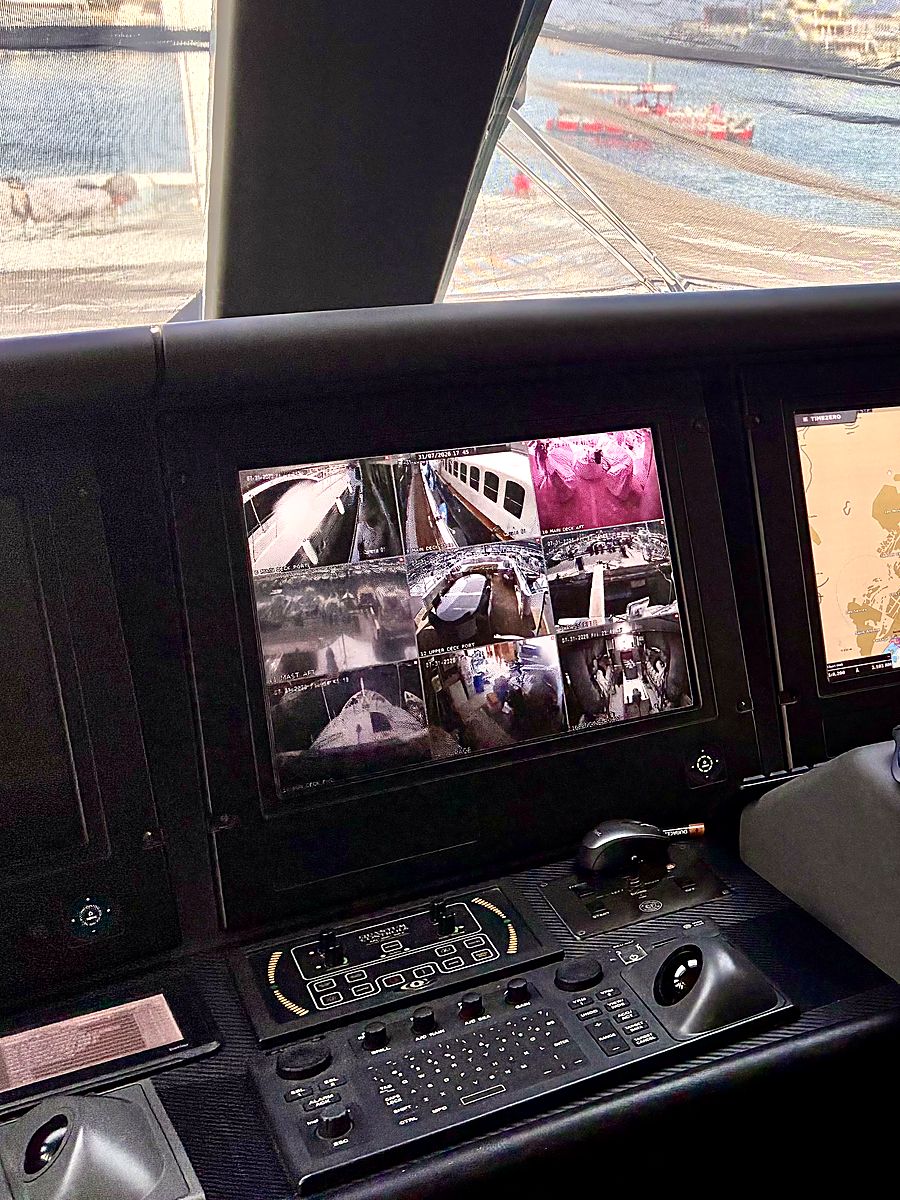
CCTV camera wall on a bridge display
Cameras, recorders, automation: often the weakest links.
01

Always connected

Starlink and 4G/5G link the vessel to the internet day and night, at the dock and at sea.

02

Supplier access

Remote access opened for maintenance and never closed again.

03

Factory passwords

Cameras, NMEA gateways, automation processors: often as delivered.

04

Mixed networks

A guest Wi-Fi that can see the cameras or the navigation PC.

The assessment

Five areas, built on the inventory

The assessment follows the IMO guidelines: identify, protect, detect, respond, recover. The Trident inventory already covers "identify", so nothing is surveyed twice.

1

Networks and segmentation

VLANs, separation of crew, guest, navigation, technical and CCTV networks, firewall rules.

2

Equipment hygiene

Default passwords, firmware versions, equipment no longer supported by the manufacturer.

3

Exposure and remote access

Starlink, 4G/5G, open ports, VPNs, supplier accounts and remote control tools.

4

Backups and continuity

Copies of servers and configurations (routers, automation, navigation), what to do if a system fails.

5

Crew and procedures

Accounts and passwords, USB keys and personal devices, a simple incident procedure.

A cyber-hygiene and configuration assessment, carried out with the vessel's written approval and without disrupting operations. It is neither a penetration test nor a compliance certification.
The framework

A topic now covered by regulation

Cyber risk is now part of safety management on board. The assessment provides material the captain, the manager and the insurer can use directly.

IMO · MSC.428(98)

Since 2021, the safety management system of ships under the ISM Code must address cyber risk management.

IACS · E26 and E27

Cyber resilience requirements for new ships contracted from 1 July 2024, depending on vessel type and size.

Insurers

More and more questions about on-board IT security at underwriting and renewal.

The Trident difference

On board, on the technical systems

Other providers offer remote assessments and monitoring. We go where they don't.

Remote approachTrident Survey
Questionnaire-based or remote assessmentOn-board visit, on the actual equipment, cabinets opened
Mostly office IT: computers, accounts, emailAlso navigation, audio-video, CCTV and automation
Survey repeated for each assignmentBuilt on the inventory already completed
Often tied to a subscriptionIndependent: no hardware or subscription to sell
Method

An assessment in one or two visits

Scoping

With the captain, ETO and manager: vessel status, scope, suppliers with remote access.

On-board visit

Configurations, access and versions recorded, built on the inventory, without disrupting operations.

Report

Network map, risk register by criticality, prioritised and costed action plan, incident procedure.

Follow-up

Quick fixes on the spot, check after works, then an annual review.

Packages

From the first assessment to annual review

For permanent monitoring, we prepare and secure the vessel, then refer you to a 24/7 monitoring specialist.

Cyber Flash · 2 daysCyber Full · 5 areasAnnual reviewCrew training
Contact

At your service

Tell us about the vessel, its status (commercial or private, ISM or not) and the suppliers who connect to it remotely — we'll come back to you promptly with a proposal.

info@tridentsurvey.fr